

There is a kind of poverty that has nothing to do with money. It belongs to the believer who has been given an enormous inheritance and lives as though the account were empty. He prays timidly, doubts quickly, compares himself to others and treats the promises of God as distant poetry. He is not poor. He is uninformed.
That is the problem the apostle Paul tackles in Ephesians 3, and it is the territory covered in the message “The Unsearchable Riches of Christ,” delivered by Rev. Gbade Ogunlana. This article introduces the preacher, describes the message, and then offers a full sermon study on the same passage, with teaching on faith, prayer and spiritual growth that you can use this week.
Who Is Rev. Gbade Ogunlana?
Rev. Gbade Ogunlana is the President of Gbade Ogunlana Ministries, which is headquartered in Ibadan, Nigeria. He is a television and radio teacher who teaches fluently in both English and Yoruba. He is widely known as the host of the television programmes “Darling Pastor” and “Paito Wa,” the latter a Yoruba teaching programme, and he is also an author and poet.
His programme “Bible Concepts with our Darling Pastor” and “Paito Wa” reaches listeners in Nigeria, the Gambia and South Africa, and he now pastors an online congregation called Bible City Virtual Church, where he has taught daily for years. He is married to Dr. Bosade Ogunlana, and they have children. Dr. Bosade is a marriage counsellor, and the couple are well known in Ibadan for marriage and family ministry.
For many listeners in the Yoruba-speaking world, his name is attached to patient, practical Bible teaching. He explains the text, builds the argument slowly and then brings it down to the kitchen table, the office and the marriage. That is the spirit in which the study below is written.
About the Message “The Unsearchable Riches of Christ”
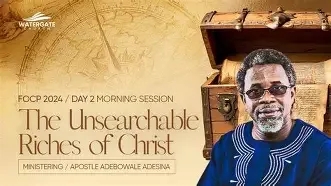
The message was delivered during the Day 2 Morning Session of FOCP 2024 and shared on YouTube in August 2024. The phrase “unsearchable riches of Christ” comes directly from Ephesians 3:8, where Paul describes the heart of his calling. The companion phrase on the video page, “the manifold wisdom of God,” appears two verses later in Ephesians 3:10. Together, the two phrases give the shape of the whole passage: Christ is richer than we can measure, and God’s wisdom is more varied than we can imagine.
Watch the full message below, then read the study that follows.
(Embed the YouTube video here.)
Sermon Study: The Unsearchable Riches of Christ
Main text: Ephesians 3:8-21
Supporting texts: Romans 10:17, 2 Corinthians 4:16, 2 Corinthians 8:9, Philippians 4:19, Colossians 2:3, Hebrews 4:16, Ephesians 1:3, Ephesians 1:7, John 14:23, Isaiah 40:31, Mark 11:24
Note: This is an original sermon written around the passage and theme above. It is not a transcript of Rev. Gbade Ogunlana’s words.
Introduction: The Prisoner Who Talked About Riches
Consider the man who wrote this chapter. Paul was in prison. Ephesians 3 opens with the words “I Paul, the prisoner of Jesus Christ.” He had no property, no freedom of movement and no promise of release. Yet from inside a Roman cell, he wrote about riches that cannot be traced, wisdom that has many colours and power that works beyond human imagination.
That detail should stop us. If riches meant bank balances, Paul would have been the poorest man in the empire. But he writes like someone standing on a mountain of treasure. Why? Because he had located the real wealth. He had found that everything the human heart truly needs, forgiveness, purpose, belonging, strength, wisdom and love, is stored in a Person, and that Person lives in the believer by faith.
Let us read the key verses together. Ephesians 3:8-12: “Unto me, who am less than the least of all saints, is this grace given, that I should preach among the Gentiles the unsearchable riches of Christ; And to make all men see what is the fellowship of the mystery, which from the beginning of the world hath been hid in God, who created all things by Jesus Christ: To the intent that now unto the principalities and powers in heavenly places might be known by the church the manifold wisdom of God, According to the eternal purpose which he purposed in Christ Jesus our Lord: In whom we have boldness and access with confidence by the faith of him.”
Then verses 14 to 21, which form one of the greatest prayers in Scripture: “For this cause I bow my knees unto the Father of our Lord Jesus Christ, Of whom the whole family in heaven and earth is named, That he would grant you, according to the riches of his glory, to be strengthened with might by his Spirit in the inner man; That Christ may dwell in your hearts by faith; that ye, being rooted and grounded in love, May be able to comprehend with all saints what is the breadth, and length, and depth, and height; And to know the love of Christ, which passeth knowledge, that ye might be filled with all the fulness of God. Now unto him that is able to do exceeding abundantly above all that we ask or think, according to the power that worketh in us, Unto him be glory in the church by Christ Jesus throughout all ages, world without end. Amen.”
This passage will teach us how to see, how to approach and how to grow. We begin with the one who is speaking.
Point One: Grace Given to the Least
Paul introduces himself with startling humility. “Unto me, who am less than the least of all saints, is this grace given.” The Greek behind the phrase “less than the least” is a made-up superlative. Paul stretches the word least into something even smaller. He is saying, in effect, that he is the lowest of the low.
Why would a man who wrote half the New Testament describe himself this way? Because he never forgot what he had been. He had persecuted the church. He had stood by while Stephen was stoned. Whatever he achieved afterward, he knew that the only explanation was grace. Notice the passive voice: “this grace is given.” He did not earn it, negotiate for it or deserve it.
This sets the tone for everything that follows in the chapter. The riches of Christ are not distributed according to merit. They flow downward from the throne, not upward from the achievements of the recipient. That is good news for anyone who feels unqualified. If grace could reach the least of all saints and make him an apostle to the nations, grace can reach you.
Many of us have a hidden belief that God’s blessings are a kind of wage, paid in proportion to how well we have behaved. On good days we expect much, on bad days we expect nothing. This belief produces a roller-coaster Christian life, with confidence rising and falling with performance. But Paul’s testimony closes that door. He was less than the least, and the grace was given anyway.
Observe also what the grace was for: “that I should preach among the Gentiles.” Grace is not only a gift to keep. It is a gift to deliver. Paul received riches so that he could announce them to others. Nobody who truly understands grace can keep quiet about it.
Application: Think of the thing you consider your greatest disqualification. Tell God plainly about it, then thank Him that His grace was never dependent on your record. Receive it as a gift, and ask Him to show you who needs to hear about it.
Point Two: Riches That Cannot Be Traced
Paul calls the riches of Christ “unsearchable.” The word he chooses means untraceable, like footprints that cannot be followed to their end, or a river whose source cannot be located. It describes something so vast that no human being can map it fully.
Think about what that implies. You can inventory a business. You can count the contents of a bank vault. You can measure a field. But you cannot catalogue the riches of Christ, because they have no boundary. Every time you think you have grasped the extent of what God has given, another dimension opens.
The New Testament does give us glimpses. Ephesians 1:3 says God “hath blessed us with all spiritual blessings in heavenly places in Christ.” Notice the word all. Not some, not most. Ephesians 1:7 speaks of redemption through His blood and the forgiveness of sins “according to the riches of his grace.” Colossians 2:3 says that in Christ “are hid all the treasures of wisdom and knowledge.” Second Corinthians 8:9 reminds us that though He was rich, for our sakes He became poor, that we through His poverty might be rich. And Philippians 4:19 promises that “my God shall supply all your need according to his riches in glory by Christ Jesus.”
Pause on that last phrase. The supply is not according to your level of income, or your network, or the economy of your country. It is according to His riches in glory. The measuring stick is God’s own wealth, and that stick has no end.
What kind of riches are these? They are the riches of a clear conscience, because the debt has been paid. They are the riches of belonging, because we have been adopted into the family of God. They are the riches of purpose, because we have been given work that matters in eternity. They are the riches of peace, because the Lord of all circumstances has taken residence in our hearts. They are the riches of wisdom, because the One who made everything is willing to guide us. They are the riches of hope, because the story does not end at the grave.
Notice that none of these can be stolen. A thief can break into a house. Inflation can shrink a salary. An accident can take away health. But the riches in Christ sit beyond the reach of markets and misfortune. Jesus told us to lay up treasure in heaven for exactly this reason: heavenly treasure does not rust, fade or get taken.
Does this mean believers will never struggle materially or physically? No. Paul himself was in chains. But it does mean that no believer is ever truly poor, because the deepest resources of a human life are already supplied.
Application: Sit down and write a list of what you have in Christ, drawing from Ephesians 1 and Colossians 2. Read the list aloud each morning for a week, and notice how it changes the tone of your prayers.
Point Three: The Mystery Now Revealed
In verse 9, Paul says he wants “to make all men see what is the fellowship of the mystery, which from the beginning of the world hath been hid in God.” In the Bible, a mystery is not a puzzle without an answer. It is a truth that was hidden for ages and has now been disclosed.
The specific mystery Paul has in mind, spelled out earlier in the chapter, is that Gentiles are fellow heirs, members of the same body, and partakers of the same promise in Christ. For centuries, Israel had been the people of the covenant, and outsiders were considered far off. Now the wall had come down. People from every tribe and tongue could enter the family of God through faith.
This is deeply relevant to us. Most readers of this article are not ethnically Jewish. We would have been counted among the outsiders. The fact that we can pray to the God of Abraham, Isaac and Jacob, call Him Father, and expect an inheritance is itself one of the astonishing revelations of Scripture.
There is a lesson here about how God works. He had this plan from before the foundation of the world. Nothing in history surprised Him. Every delay, every unanswered question, every season that looked like silence was part of a design that was moving toward its reveal. The mystery was hidden in God, not abandoned by God.
Many of us are living in a chapter that feels hidden. We have prayed for years about a situation and we see no movement. It is comforting to remember that the most important truth in history was concealed for centuries, and then revealed at precisely the right moment. If God can hide a mystery for ages and unveil it in His own time, He can handle your timeline too.
The word fellowship in the verse also deserves attention. It points to shared participation. The mystery is not only that Gentiles are included but that we all share in it together. The Christian life is not designed to be lived alone. The riches of Christ are enjoyed in community.
Application: Identify an area of your life where God seems silent. Remind yourself that hiddenness does not mean absence. Write down the words “hidden in God, not abandoned by God” and keep them where you will see them.
Point Four: The Many-Coloured Wisdom of God
Verse 10 gives a remarkable purpose for the church: “to the intent that now unto the principalities and powers in heavenly places might be known by the church the manifold wisdom of God.”
The word manifold translates a Greek term that means many-coloured, or richly varied. It was used for embroidered cloth and for intricate patterns. The picture is of God’s wisdom as a tapestry, with threads of different shades woven together into a design that no single thread can show alone.
Look at what is being said. The church, an ordinary gathering of forgiven sinners, is a stage on which the wisdom of God is displayed before the spiritual powers of the universe. Angels look on. Even the rebellious spirits watch. And what do they see? A community of people from different nations, backgrounds, ages and temperaments, united by one Lord and growing into holiness. That sight reveals a wisdom that the powers themselves could not have devised.
This teaches us to treat the church with greater respect. It is easy to see the local assembly as a collection of imperfect people with irritating habits. But heaven sees it as a showcase. Every time a family forgives another, every time a rich member serves a poor one, every time a quarrel is resolved in humility, the manifold wisdom of God is on display.
The same idea applies to your personal journey. God’s wisdom for your life is manifold. He does not repeat the same pattern for every person. He guided Joseph through a pit, a prison and a palace. He led David through a sheepfold, a battlefield and a throne. He took Moses through a palace, a desert and a mountain. If your story looks different from someone else’s, it does not mean you are behind. It means a different design is being woven.
Notice also that this was according to “the eternal purpose which he purposed in Christ Jesus our Lord.” Everything fits into a purpose that began before time. You are not an accident in a random universe. You are part of a plan that was set in eternity and is being carried out in history.
Application: Look back over the past five years of your life. Trace the unexpected turns, the closed doors and the surprising openings. Ask the Lord to help you see the pattern He has been weaving, and thank Him for the threads you did not understand at the time.
Point Five: Boldness and Access
Verse 12 is a gift to every person who has ever hesitated to pray. “In whom we have boldness and access with confidence by the faith of him.”
Three words carry the weight: boldness, access and confidence. Boldness means the freedom to speak openly, without fear. Access means a door that is open and a way in. Confidence means settled assurance that we will be welcomed. All three are ours “in him” and “by the faith of him.”
In the ancient world, approaching a king was a risky business. You could not just walk into the throne room. Protocol, permission and fear stood in the way. Yet the New Testament says that through Jesus, believers may walk into the presence of the King of the universe at any hour. Hebrews 4:16 puts it this way: “Let us therefore come boldly unto the throne of grace, that we may obtain mercy, and find grace to help in time of need.”
Why is this true? Not because we are impressive, but because of the finished work of Christ. His blood opened the door. His righteousness covers us. His intercession keeps the way clear. The basis of our confidence is not the quality of our prayers but the quality of our Saviour.
This changes how we pray. Many believers approach God as though they were beggars at a locked gate, hoping the guard will take pity. But the New Testament pictures children entering their father’s house. A child does not rehearse a speech before asking for water. A child speaks naturally, openly and expectantly.
This does not make prayer casual in the sense of careless. Reverence remains. The same Paul who tells us to come boldly will, in the next breath, bow his knees. But the posture of reverence and the posture of confidence are not opposites. A person can be both awestruck and at home.
It also means that you do not need to wait until you feel holy to pray. Pray when you feel guilty and bring the guilt to the cross. Pray when you feel afraid and bring the fear to the Father. Pray when you feel nothing at all, because the access does not depend on emotion. It depends on Christ.
Application: Next time you pray, begin by consciously acknowledging that you come in the name and merit of Jesus, not your own. Then speak honestly, as a child to a father, without pretence.
Point Six: Do Not Faint
Verse 13 is short but brave. “Wherefore I desire that ye faint not at my tribulations for you, which is your glory.”
Paul knows that his Ephesian readers are worried. Their spiritual father is in prison. If the apostle can be arrested, what hope do ordinary believers have? Their courage is at risk. So he writes to them with a request: do not lose heart.
Notice that he reframes his suffering. His chains are not a sign that God has failed. They are happening “for you,” and they are “your glory.” The word glory here means honour. His imprisonment is the cost of carrying the gospel to them, and it testifies to how valuable the message is.
There is a lesson for anyone passing through trouble. Pain does not cancel the riches of Christ. A believer can be in a cell, a hospital bed or a financial crisis and still be the heir of God. Circumstances can affect comfort, but they cannot revoke the inheritance.
The command not to faint is also a reminder that discouragement is a real spiritual danger. Faint means to give up, to lose heart, to grow weary and quit. Isaiah 40:31 promises that those who wait on the Lord shall renew their strength, mount up with wings as eagles, run and not be weary, walk and not faint. The way not to faint is to keep waiting on God, keep looking to Christ and keep drawing from the supply.
If you are tired today, hear this as a pastoral word. You are not failing because you are weary. Even Paul needed encouragement. What matters is where you take your weariness. Take it to the One whose riches have no bottom.
Many believers in Nigeria and across Africa know hardship in a way that is hard to explain to outsiders. Power outages, rising prices, insecurity, exam pressures, delayed breakthroughs and family burdens can weigh on the spirit. This verse tells us that none of these things have the right to define our standing. We are not people whose worth rises and falls with the economy. We are people who own what cannot be shaken.
Application: Name the burden that tempts you to faint. Speak to your own heart the way Paul spoke to the Ephesians: do not lose heart. Then pray through the burden slowly, handing each part to the Lord.
Point Seven: The Posture of Prayer
At verse 14, Paul turns from teaching to praying. “For this cause I bow my knees unto the Father of our Lord Jesus Christ.”
Bowing the knees was not the usual Jewish posture for prayer. Standing with raised hands was more common. Kneeling suggested deep earnestness, as when Jesus knelt in Gethsemane. Paul is communicating that this prayer comes from the depth of his being.
Look at who he addresses: “the Father of our Lord Jesus Christ, of whom the whole family in heaven and earth is named.” Every family takes its identity from a father. Paul is saying that the entire family of God, those who have gone before and those still on earth, is named after this Father. When we pray, we do not pray to a distant deity. We pray to the head of a family to which we belong.
Prayer is therefore relational before it is transactional. Yes, we make requests. Jesus told us in Mark 11:24 to believe that we receive when we pray. But requests grow out of relationship. A child who only visits his father when he needs money has misunderstood what a father is for. The deepest prayer is simply being with the Father.
Paul also teaches us something about the content of prayer. This prayer is not about houses, cars or promotions, though God cares about those too. It is about strength, indwelling, love and fullness. Paul asks for the things that matter most and trusts that the lesser things will be supplied. This is what Jesus meant when He said to seek first the kingdom of God.
If you struggle to know what to pray, borrow Paul’s words. Pray this passage for yourself, your spouse, your children and your church. Insert the names. Let the structure of the prayer shape your own.
Application: Set aside a time this week to pray Ephesians 3:14-21 aloud, slowly, once for yourself and once for someone you love. Kneel if you are able. Let the body join the heart.
Point Eight: Strength in the Inner Man
Now we come to the first request. Paul asks that the Father would grant, “according to the riches of his glory, to be strengthened with might by his Spirit in the inner man.”
Notice the measure again. The strength is given according to the riches of His glory, not according to our resources. Notice the agent: the Holy Spirit. And notice the location: the inner man.
The inner man is the real you, the part of you that thinks, chooses, feels and relates to God. Second Corinthians 4:16 says, “Though our outward man perish, yet the inward man is renewed day by day.” The body ages. Strength fades. Eyesight dims. But the inner person can grow stronger every day.
Most of us pour our energy into the outer man. We exercise, groom, decorate and shop. None of that is wrong, but it is incomplete. A person with a well-developed body and a weak spirit is dangerously unbalanced. When crisis comes, the inner man determines whether we stand or fall.
How is the inner man strengthened? Paul says it happens by the Spirit. This points us to the ordinary means through which the Spirit works: the word of God, prayer, worship, fellowship and obedience. A believer who feeds on Scripture daily, prays consistently, worships honestly, stays in fellowship and obeys promptly will grow strong, however modest the outward circumstances.
This is spiritual growth in its simplest form. It is not mysterious. It is the steady habit of taking in what God supplies. A plant does not strain to grow. It stays in the soil, receives water and sunlight and grows. In the same way, we grow when we stay in the Word, stay in prayer and stay in the presence of God.
The strengthening is also “with might.” The word is dynamic, as in power. God does not offer us a pale, theoretical strength. He offers real, working power to resist temptation, forgive enemies, endure suffering, speak truth and keep going when the road is long.
Application: Examine your weekly routine. How much time goes to the outer man, and how much to the inner? Decide on a modest, regular rhythm of Bible reading and prayer, and begin it tomorrow morning.
Point Nine: Christ Dwelling in the Heart by Faith
The second request is the centre of the prayer: “that Christ may dwell in your hearts by faith.”
At first glance this seems odd. Paul is writing to believers. Does Christ not already live in them? Yes, He does, from the moment of conversion. But the word dwell here means to settle down, to be at home, to take up permanent residence. Paul is praying that Christ would be allowed to feel at home in every room of the believer’s heart.
Imagine a house where you are a guest. You have a key and a room, but some doors are locked, and you are not free to move about. That would not feel like home. Many of us have received Christ into our lives but still keep certain rooms closed: a private habit, a financial decision, a relationship, a secret ambition. Paul prays that the guest would become the master of the house.
The means by which this happens is faith. Not effort, not religion, not self-improvement, but faith. Faith is trusting Christ enough to give Him access to everything. It is agreeing with what He says, relying on what He has done and acting on what He asks.
Here a word about faith is essential, since the theme of faith runs through so much of the teaching ministry of Rev. Gbade Ogunlana and through the whole of the New Testament. Faith is not a feeling of certainty. It is not forcing yourself to believe something unbelievable. Romans 10:17 gives us the source: “Faith cometh by hearing, and hearing by the word of God.” Faith grows as we hear God’s word, understand it and settle our hearts on it. That is why teaching ministries that open the Bible patiently are so valuable. They feed the soil in which faith grows.
Faith also expresses itself in action. Abraham believed God and set out for a land he had never seen. A farmer who believes in harvest plants seed. Faith that never moves a foot is not yet the faith the Bible describes. When we believe that Christ is at home within us, we begin to live differently. We speak with less fear, give with more generosity and forgive with greater ease.
John 14:23 shows the same idea from Jesus’ own lips: “If a man love me, he will keep my words: and my Father will love him, and we will come unto him, and make our abode with him.” Abode is the same idea as dwelling. The Father and the Son make their home in the person who loves and obeys.
Application: Ask the Lord which room in your heart you have kept closed to Him. Hand Him the key in prayer. Make one practical step of obedience in that area this week.
Point Ten: Rooted and Grounded in Love
Paul continues: “that ye, being rooted and grounded in love.” Two images are combined here. Rooted is from agriculture, like a tree sinking roots into soil. Grounded is from construction, like a building laid on a foundation. One picture is organic, the other architectural. Both say the same thing: stability.
What is the soil and the foundation? Love. Not our love for God alone, but supremely His love for us, and the love that flows from it among believers. A believer who is certain of being loved will not be swayed by every storm of criticism or failure. A tree with deep roots survives wind. A house on a firm foundation survives flood.
This explains why so many believers feel unstable. They have built their security on performance, popularity, possessions or position, and when any of these shifts, they shake. Paul invites us to relocate our identity. We are loved by God before we accomplish anything. We are loved when we fail. We are loved when no one else notices. That love is the soil.
It also has implications for relationships. People who are rooted in love are better husbands, wives, parents, colleagues and friends. They do not need to demand applause or control others, because their needs are already met in Christ. Marriage ministry, such as that conducted by Rev. Gbade Ogunlana and his wife Dr. Bosade Ogunlana, depends on this very foundation. A home built on love that is rooted in God can withstand pressures that would crush a home built on convenience.
Application: Ask yourself where you have been drawing your security from. If it is anything other than the love of God, begin to replace that source. Read Romans 8:35-39 slowly, and let it settle in your heart.
Point Eleven: The Love That Passes Knowledge
The next phrase stretches the imagination: “may be able to comprehend with all saints what is the breadth, and length, and depth, and height; and to know the love of Christ, which passeth knowledge.”
Paul lists four dimensions without naming the object. Breadth, length, depth and height of what? The context points to the love of Christ. It is broad enough to include every nation. It is long enough to last from eternity past to eternity future. It is deep enough to reach the lowest pit of human failure. It is high enough to lift us to a seat in heavenly places.
Then comes the paradox. We are to know a love that passes knowledge. In other words, we are asked to understand something that cannot be fully understood. This is not a contradiction. A child can know that a mother loves him without being able to measure the extent of that love. In the same way, we can truly know the love of Christ while still discovering new depths of it for the rest of our lives.
Notice the phrase “with all saints.” This kind of knowing is not private. It happens in company. Individual believers see a part of the picture, and together the church sees more. This is one more reason to stay connected to a local congregation. Your fellow believers have seen angles of God’s love that you have not, and you have seen angles that they need.
How do we grow in this knowledge? By meditating on the cross. By remembering what God has done for us in specific moments. By reading the gospels slowly and watching how Jesus treated people. By serving others and noticing how His love moves through us. By practising gratitude daily.
When we begin to grasp even a fraction of this love, prayer changes. We stop coming to God only with lists and start coming to Him with wonder. Worship becomes natural. Obedience becomes joy instead of burden.
Application: Choose one passage from the gospels, perhaps the account of the woman at the well or the raising of Lazarus, and read it slowly. Ask what it shows about the love of Christ. Write down one insight and thank Him for it.
Point Twelve: Filled With All the Fullness of God
The prayer reaches its peak: “that ye might be filled with all the fulness of God.”
It is hard to imagine a higher request. Paul is not asking that we receive a little of God, or enough of God to survive, but that we be filled with God’s own fullness. The word fullness points to completeness, the full measure of what God is and gives.
What would this look like in practice? A believer filled with the fullness of God has a character that resembles Christ: patient, kind, truthful, courageous and humble. Such a person carries the presence of God into every room. They discern what others miss. They love without calculating. They endure without bitterness.
This is the goal of spiritual growth. It is not merely to know more Bible facts, attend more meetings or perform more religious tasks. It is to be increasingly filled with God Himself, so that our whole personality becomes a vessel for His life.
Does this happen instantly? The New Testament suggests a process. We are filled as we are strengthened, as Christ dwells in us more fully, as we are rooted in love and as we know that love more deeply. The prayer builds step by step, like a staircase, to this summit. There are no shortcuts, but each step is attainable.
A word of encouragement for those who feel far from this ideal. Paul prays this prayer for ordinary believers in Ephesus, people with jobs, families and struggles, in a city full of idols. He does not suppose they are already mature. He prays that they will grow. The prayer itself shows that God intends and enables this kind of growth for everyone who is willing.
Application: Make this a personal prayer: “Lord, fill me with Your fullness, not for my reputation but for Your glory and for the good of others.” Pray it daily for the next month and keep a short journal of how the Lord answers.
Point Thirteen: Exceeding Abundantly Above All
The chapter ends with one of the grandest doxologies in the Bible. “Now unto him that is able to do exceeding abundantly above all that we ask or think, according to the power that worketh in us.”
Pile up the phrases and notice the escalation. Able. Do. Abundantly. Exceeding abundantly. Above all. Above all that we ask. Above all that we think. Paul is reaching for language and still falling short. The point is that God’s capacity is greater than our largest request and our wildest imagination.
This should shape the size of our prayers. Many believers pray small because they have settled for a small view of God. They ask for what seems reasonable, what feels safe, what will not embarrass them if unanswered. But this verse invites us to stretch. Ask big. Dream within God’s will. Plan with faith. Our imagination is not the ceiling.
Yet notice the final clause: “according to the power that worketh in us.” The measure of what God does is the power already working inside the believer. It is not outside of us or only in heaven. It is within, in the Spirit who lives in us. That same power raised Jesus from the dead. If it can empty a tomb, it can handle whatever you are facing.
The passage closes with glory: “Unto him be glory in the church by Christ Jesus throughout all ages, world without end. Amen.” All of this, the riches, the wisdom, the access, the strength, the love and the fullness, exists for the glory of God. Our spiritual growth is not ultimately about us. It is about God being displayed through a people who are rich in Him.
Application: Write down one prayer request that you have been afraid to ask because it seems too large. Bring it to God today, grounded in His power and His will, and leave the outcome with Him.
Putting It All Together
Let us gather what the passage has taught us. Grace reaches the least, which means no one is disqualified. The riches of Christ are unsearchable, which means our supply has no floor. The mystery has been revealed, so we belong to a plan that predates time. The wisdom of God is manifold, so our individual stories do not need to look alike. In Christ we have boldness and access, so prayer is an open door. We are told not to faint, because trouble does not cancel the inheritance. Paul bows his knees and shows us how to pray for what matters most: inner strength, Christ at home in the heart, a life rooted in love, a growing knowledge of the love that surpasses knowledge, and fullness of God. And all of it rests on a God who is able to do more than we imagine.
If this study were turned into a plan for spiritual growth, it might look like this. Begin each day with the Bible, even if only briefly, because faith comes by hearing the word. Pray with the boldness that Christ has earned for you, speaking to God as a child to a father. Pray Ephesians 3:14-21 for yourself and for others. Identify the room in your heart where Christ is not yet fully at home and open it to Him. Stay planted in a local church where the word is taught and love is practised. Serve someone every week, because love grows in the act of giving. And when you grow weary, remember the prisoner who refused to faint, and keep going.
A Closing Prayer
Father of our Lord Jesus Christ, we bow before You with grateful hearts. Thank You for grace that reaches the least of us. Thank You for riches in Christ that cannot be traced to their end. Thank You that the mystery once hidden is now revealed, and that we are included.
Open our eyes to see what we have received. Where we have lived as spiritual paupers, show us our inheritance. Where we have doubted, build our faith through Your word. Where we have hesitated to pray, remind us that the door is open through Jesus.
Strengthen us with might by Your Spirit in the inner man. Let Christ dwell in our hearts by faith, settled and at home in every room. Root and ground us in Your love. Help us comprehend, with all the saints, the breadth, length, depth and height of the love of Christ, and fill us with all Your fullness.
Do for us, Lord, exceeding abundantly above all that we ask or think, according to the power that works in us. Be glorified in Your church and in our lives, now and forever. In the name of Jesus we pray. Amen.
Final Thought
The most important discovery a believer can make is not a new technique, a new programme or a new season. It is the discovery of what has already been given in Christ. Paul called it unsearchable because it cannot be exhausted, but he never meant that we should stop searching. He meant that the search will be the joy of a lifetime. Keep digging in the word, keep bowing in prayer and keep believing the One who is able. You are richer than you know.
Frequently Asked Questions
Who is Rev. Gbade Ogunlana?
He is the President of Gbade Ogunlana Ministries, based in Ibadan, Nigeria, and a television and radio teacher who teaches in English and Yoruba. He is popularly known as Paito Wa and the Darling Pastor.
What does “the unsearchable riches of Christ” mean?
The phrase comes from Ephesians 3:8. It describes the vast, untraceable spiritual wealth that believers have in Christ, including forgiveness, wisdom, peace, belonging, strength and hope. The word unsearchable suggests that these riches cannot be fully mapped or exhausted.
Where can I watch the sermon?
The message was shared on YouTube from the FOCP 2024 Day 2 Morning Session by the Apostle Adebowale Adesina channel. You can also watch it in the video player at the top of this page.
Is this article a transcript of the sermon?
No. The study above is an original message written around Ephesians 3 and the theme of the sermon. For Rev. Gbade Ogunlana’s exact words, please watch the video.
What is the main prayer in Ephesians 3?
In Ephesians 3:14-21, Paul prays that believers would be strengthened in the inner man by the Spirit, that Christ would dwell in their hearts by faith, that they would be rooted in love, that they would know the love of Christ, and that they would be filled with the fullness of God.
How can I grow spiritually based on this passage?
Feed on the Bible daily, pray with confidence through Jesus, stay connected to a local church, obey God promptly in small matters, and keep asking the Lord to strengthen your inner life. Spiritual growth comes through steady habits over time.