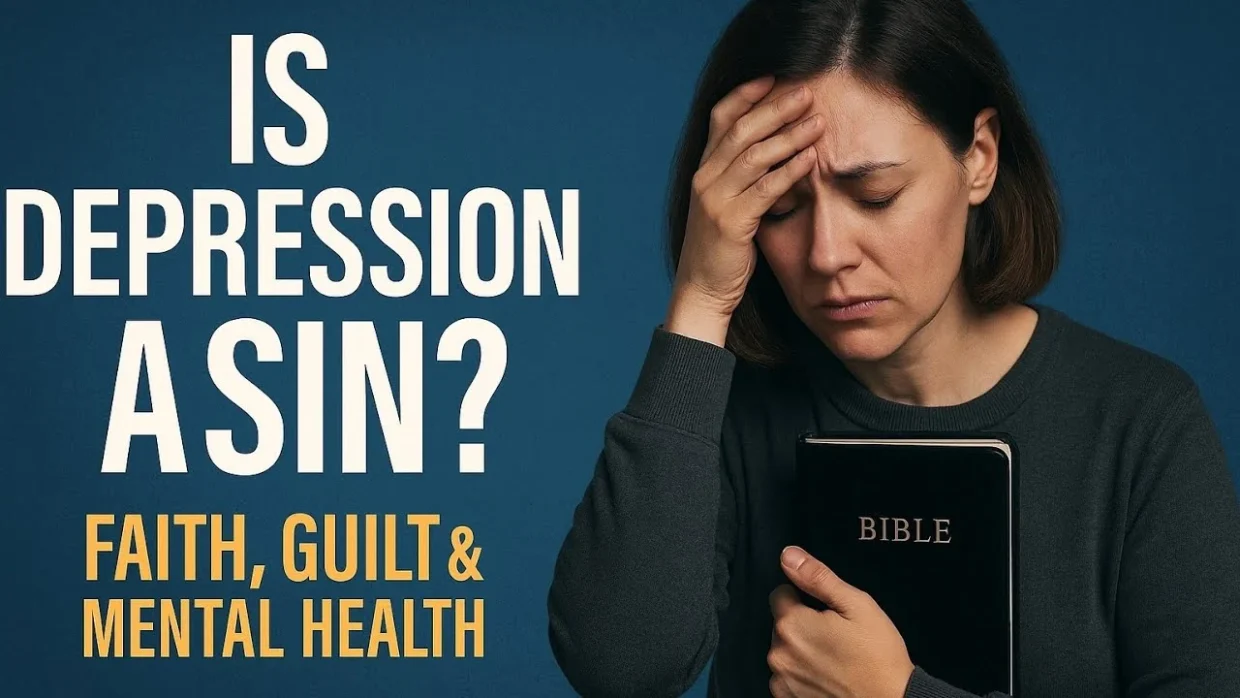
She sat in the last row of the sanctuary every Sunday for almost a year. Let me call her Ruth. She sang along with the worship team, she dropped her offering in the plate, and she left before anyone could talk to her. One evening she finally knocked on my office door, sat down, and whispered, “Pastor, I think God is angry with me. I have not felt anything in months. I cannot pray. I cannot cry. I cannot even get excited about my own children. Is this depression, and is it a sin?”
I have heard some version of Ruth’s question for twenty years. I have heard it from usher board members, from worship leaders, from pastors’ wives, and from pastors themselves. Behind the question is a heavy load of guilt. Believers who are already suffering inside are afraid that the suffering itself is evidence against them.
I want to answer that question plainly and gently, as a pastor and as a mental health advocate who has walked with hundreds of people through the valley. We will look at what depression actually is, what Scripture shows us about sorrow, where the confusion comes from, and what real healing looks like for a believer. If you are hurting as you read this, please keep going. This was written with you in mind.
The Question Behind the Question
When a believer types, “Is depression a sin?” into a search bar, they are rarely asking for a theology lecture. They are usually asking three deeper questions.
First: “Is something wrong with my faith?” They wonder whether a stronger believer would not feel this way.
Second: “Is God disappointed in me?” They fear that heaven’s response to their heaviness is a frown.
Third: “Is there any hope for me?” They are tired, and they want to know whether the darkness can lift.
Let me answer all three right now so you do not have to wait. No, depression is not proof that your faith is weak. No, God is not standing over you with His arms crossed. And yes, there is real hope, because depression is among the most treatable conditions we know of, and God works through many kinds of help.
Now let us walk through the reasons why, so you can stand on solid ground and not just on my word.
What Depression Actually Is (and What It Is Not)
Part of the confusion is that we use one word for very different experiences. Everyday language says, “I am so depressed that my team lost,” and that is ordinary sadness. Clinical depression is something else.
Think about the difference between a rainy afternoon and a long, dark winter that will not end. Sadness is the rainy afternoon. It comes after a loss or disappointment, it feels heavy, and then it passes as life moves on. Depression is the winter that settles in and does not leave when the calendar says it should.
Clinical depression often involves several of these experiences lasting for weeks or longer:
- A persistent low mood, emptiness, or numbness
- Loss of interest or joy in things you used to love
- Changes in sleep, either too little or too much
- Changes in appetite or weight
- Deep fatigue that rest does not fix
- Trouble concentrating or making decisions
- Feelings of worthlessness or heavy guilt
- Withdrawing from people
- Thoughts that life is not worth living
Notice that many of these are physical and mental, not just emotional. Depression affects the brain and body, including sleep patterns, energy, and the way the brain processes mood and motivation. It is not simply a bad attitude. It is not laziness. It is not a lack of gratitude.
Here is another picture. Imagine your mind as a car. In ordinary sadness, the car is working fine but you are driving through a rough road. In depression, the engine itself is struggling. You can press the gas pedal as hard as you like, and the car still barely moves. Telling that driver to just try harder misses the problem entirely.
What Scripture Shows Us About Sorrow
If depression were a straightforward sin, we would expect the Bible to condemn those who experienced deep despair. Instead, the Bible is full of faithful people who sank very low.
Elijah won a stunning victory on Mount Carmel. A few days later he ran into the wilderness, sat under a tree, and asked God to let him die. Look at God’s response. He did not scold the prophet. He sent an angel who let him sleep, then fed him, then let him sleep again. God treated Elijah’s exhaustion with rest and food before giving him any new instruction.
David, a man after God’s own heart, wrote about being worn out from groaning, drenching his bed with tears, and feeling his soul bowed down. Many of the psalms read like the diary of a person walking through deep darkness, and they were included in the holy Scriptures on purpose.
Job lost his children, his wealth, and his health. He wished he had never been born. His friends insisted that his suffering must be caused by some hidden sin, and God Himself rebuked them for it. Read that again: the people who assumed his pain meant guilt were the ones who were wrong.
Jeremiah is known as the weeping prophet. Even Jesus, in Gethsemane, told His disciples that His soul was overwhelmed with sorrow to the point of death. He is called a man of sorrows, acquainted with grief.
When you gather these stories together, a clear pattern emerges. Deep sorrow, exhaustion, and despair are part of the human experience, including the experience of faithful people. The Bible never treats them as an automatic sign of rebellion against God.
Where the “Depression Is a Sin” Idea Comes From
If Scripture shows so much compassion, why do so many believers carry this belief? Let me name a few sources, because understanding the roots can help us pull the weeds.
Misreading verses about joy and rejoicing. Passages like “Rejoice in the Lord always” are sometimes used like a club. But those verses were written to people who were suffering, and they invite us toward joy as a deep anchor, not as a mandatory emotion on demand. Joy in Scripture often grows in the soil of hardship. It does not require us to fake a smile.
Confusing sorrow with unbelief. Some of us were taught that if we truly trusted God, we would never feel heavy. But trust is not the absence of tears. Abraham’s servant, Hannah, and Paul all wept while trusting God.
Cultural pressure to be strong. In many communities, including mine, there is a proud tradition of resilience. We say, “We have been through worse.” Resilience is beautiful, but it can turn into a rule that says showing weakness is shameful.
Lack of mental health education. Many sincere leaders were never trained to tell the difference between spiritual dryness, grief, and clinical depression. When they only have a spiritual toolbox, every problem looks like a spiritual problem.
Fear. Mental illness frightens people. It is easier to say, “Just pray harder,” than to admit that someone we love may need medical care.
None of these roots are evil. They are usually well intended. But the fruit can be devastating, because they teach suffering believers to hide.
Can Spiritual Struggles and Depression Overlap?
I do not want to oversimplify, so let me be honest about the full picture. Spiritual life and mental health are connected. They are not identical, but they do touch each other.
Sometimes a believer carries guilt or unresolved sin that weighs heavily on their emotions. King David described in one of his psalms how his bones wasted away while he kept silent about his wrongdoing, and how confession brought relief. Hidden guilt can indeed press on a person’s spirit.
Sometimes a spiritual season of dryness, sometimes called a wilderness or a dark night of the soul, looks like depression on the surface, even though it is different underneath. God sometimes draws us into deeper trust through seasons where we do not feel His presence.
And sometimes the spiritual struggle comes after depression begins. The heaviness makes prayer feel impossible and Scripture feel flat. Then guilt over not praying piles on top, and the person spirals further.
So how do we tell the difference? That is where wise counsel matters. A pastor and a trained mental health professional can work together to understand what is going on. The important point is this: having spiritual questions does not mean your depression is merely a spiritual failure, and having depression does not mean your spiritual life must be ignored. God cares about the whole person, and so should we.
Why the Guilt Makes Depression Worse
Here is something I have seen again and again. The belief that “my depression is a sin” is not neutral. It acts like fuel.
Imagine you are already carrying a heavy backpack up a steep hill. Someone then drops a second, bigger backpack on your shoulders and says, “You should be ashamed that you are tired.” That is what happens when a depressed believer is told their condition is a moral failing. The guilt adds weight to an already exhausted person.
Shame is a powerful force. It tells people to hide, to avoid church, to stop talking to friends, to hold back from asking for help. But isolation is one of the main things that deepens depression. The very belief meant to motivate repentance can drive someone further into the pit.
This is why a compassionate response is not softness. It is wisdom. When we remove the shame, we open the door for people to speak, to seek treatment, and to experience God’s comfort. The Bible says that God draws near to the brokenhearted. We should do the same.
The Story of Ruth, and What Healing Looked Like
Let me return to Ruth in my office. After we talked, I did not give her a verse to memorize and send her off. I told her what I am telling you now: that she was not in trouble with God, and that what she was experiencing deserved care.
We prayed together, but we also made a plan. She saw her doctor, who checked for physical contributors and referred her to a counselor. She began meeting with a licensed therapist who taught her practical skills. She joined a small group of women at our church, one of whom quietly shared that she had walked a similar road. She started a gentle daily walk, and on the hardest days we agreed she would simply sit by a window with the curtains open.
Healing was not instant. There were setbacks. There were weeks she still sat in the last row. But slowly, the numbness began to lift. About eight months in, Ruth told me, “Last Sunday I cried during worship, and it felt wonderful. I did not know I could feel again.”
That is what recovery often looks like. It is rarely a lightning bolt. It is usually a patient return to life, with God present in every small step and often working through doctors, counselors, friends, and community.
Practical Steps If You Are Struggling With Depression
If you recognize yourself in this article, here are some steps you can take. You do not have to do them all at once. Choose one today.
1. Tell one safe person. Depression thrives in secrecy. Choose a trusted friend, family member, pastor, or counselor, and say, “I have been struggling, and I need help.” The relief of saying it out loud can be surprising.
2. Make a doctor’s appointment. A physician can check for physical contributors, such as thyroid problems, vitamin deficiencies, or side effects of medications, and can talk to you about treatment options. Think of this as part of taking care of the temple God gave you.
3. Consider therapy. Talk therapy gives you tools to work through painful thoughts and patterns. Many therapists are comfortable including a person’s faith in the conversation, and you can ask about that when you call.
4. Keep the basics going. On bad days, do the smallest version of the basics: a glass of water, a simple meal, a shower, ten minutes outside in daylight. Sleep as regularly as you can. These are not cures, but they are supports.
5. Move your body gently. A short walk can lift mood, especially in the morning light. Start with five minutes if that is all you can do.
6. Pray in small pieces. If long prayers feel impossible, pray one sentence at a time. “God, help me.” “Be near me.” “I do not feel You, but I am here.” Scripture tells us that the Spirit intercedes for us with groanings too deep for words. You are not required to be eloquent.
7. Read the psalms of lament. Let David and the other psalmists speak the words you cannot find. Reading honest prayers can remind you that your feelings are not forbidden in God’s presence.
8. Stay connected. Even when you feel like pulling away, try to keep one small thread of connection, whether that is a short call, a text, or sitting in the back row of church with a trusted friend.
9. Be patient with the process. Recovery has good days and hard days. A hard day does not erase your progress. Treat yourself with the same gentleness you would offer someone you love.
What About Medication? A Word to Believers
This is a question I get all the time. “Pastor, if I take medicine for depression, does that mean I do not trust God?”
Let me answer with a simple comparison. If someone has diabetes, they take insulin. If someone has high blood pressure, they take medication. Nobody questions their faith for doing so. We understand that the body sometimes needs help. The brain is a part of the body.
For some people, medication is a helpful part of treatment, sometimes alongside therapy and lifestyle support. For others, therapy and other supports may be enough. That decision belongs between you and a qualified medical professional. Please do not start or stop any medication on your own, and do not let shame make the decision for you.
God has given human beings the wisdom to study the brain and develop treatments. Receiving that help with gratitude is not a sign of weak faith. It can be an act of faith, trusting that God works through many channels.
Helping a Loved One or Church Member Who Is Depressed
Maybe you are reading this not for yourself but for someone you care about. Here is how you can help well.
Start by listening. Resist the urge to fix, to quote a verse, or to say, “Cheer up.” Try, “I am really glad you told me. I am here, and I am not going anywhere.”
Avoid cliches like “Everything happens for a reason,” or “Just have more faith.” They sound like comfort but often land like judgment.
Offer practical help. Bring a meal. Offer a ride to an appointment. Sit with them in silence. Check in regularly, even when they do not respond right away.
Gently encourage professional help. You might say, “I care about you, and I think talking to a doctor or counselor could really help. Can I help you make the call?”
And take any talk of self harm or suicide seriously. If someone you love says they want to die or hurt themselves, do not leave them alone. Stay with them, remove access to anything they could use to hurt themselves if you can do so safely, and contact emergency services or a crisis line right away.
If you are a pastor or leader, make your church a safe place. Speak openly from the pulpit about mental health. Share your own story where appropriate. Keep a list of trusted counselors and doctors. When people see that struggle is not shameful in your church, they will find the courage to speak.
When You Need Help Right Now
I want to speak directly to anyone who is reading this while carrying thoughts of ending your life or hurting yourself. Please hear me. Your pain is real, and it is not the whole story of your life. Depression lies. It tells you that nothing will ever change, that you are a burden, and that people would be better off without you. Those are symptoms speaking, not truth.
Please reach out right now. Call your local emergency number or a crisis line in your country, go to the nearest emergency room, or tell someone near you what you are thinking. If you can, stay with another person tonight. You are deeply loved by God, and you matter to people around you more than you know. Asking for help in this moment is one of the bravest and most faithful things you can do.
So, Is Depression a Sin?
Let me answer as plainly as I can after twenty years in ministry.
Depression is not a sin. It is a real condition that affects the mind and body, and the Bible shows faithful people walking through deep sorrow without condemnation from God. Feeling heavy, empty, or hopeless does not mean you have failed spiritually. At the same time, our spiritual lives and our emotional lives do touch each other, which is why prayer, community, and godly counsel can be a real part of healing, alongside medical and professional care.
If Ruth were sitting in front of me again, I would say what I told her. You are not in trouble with God. You are not too far gone. The One who sent an angel with food and rest for Elijah, who collected David’s tears, and who wept at the tomb of His friend is near to you now.
Take one step today. Tell one person. Make one call. Drink one glass of water. Step outside for five minutes. Small steps matter, and God honors every one of them.
There is a morning coming. It may feel far away, but it is not a fantasy. It is a promise, and you do not have to walk toward it alone.